
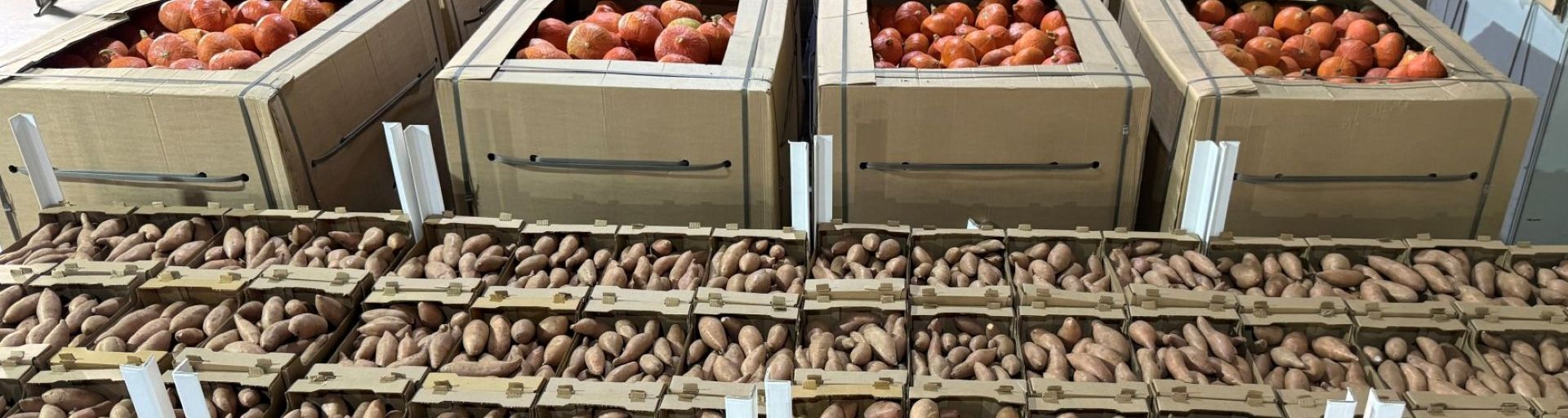
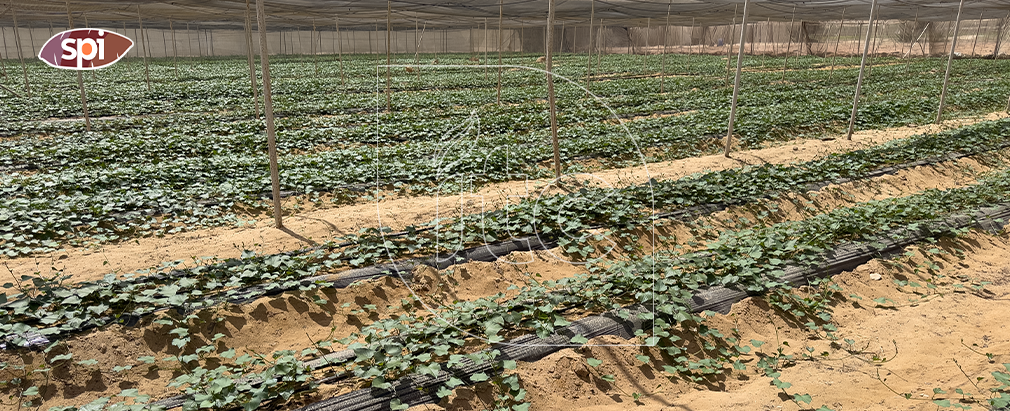
In the production of Ipomoea batatas, the physiological status of the planting material serves as the primary predictor of Sweet Potato Yield and final root morphology. The transition from nursery bedding to field establishment represents a critical phenological window where biological decisions specifically regarding seedling vigor, viral load, and hormonal priming directly dictate the eventual harvest index.
While environmental factors are significant, the biological foundation established during the propagation phase often determines the upper limit of Sweet Potato Yield potential. This technical analysis explores how SPI’s nursery-stage protocols influence vascular efficiency, carbohydrate partitioning, and periderm integrity to optimize both biomass and marketable quality.
The use of premium, pathogen-tested (virus-free) seedlings is not merely a phytosanitary measure; it is a fundamental requirement for optimal plant physiology. Sweet potato viruses, particularly the Sweet Potato Virus Disease (SPVD) complex, disrupt the plant’s internal regulatory mechanisms.
Virus-free seedlings maintain uncompromised xylem and phloem functionality. Systemic viral infections often lead to phloem necrosis or restricted vascular flow, which limits the translocation of photosynthates from the source (leaves) to the sink (storage roots). By ensuring a clean start, plants achieve maximum carbohydrate allocation during the bulking phase.
There is a direct physiological correlation between seedling vigor and the subsequent synthesis of structural polymers, which are the primary drivers of a high-index Sweet Potato Yield. Pathogen-free, high-vigor plants exhibit superior cell wall thickness and secondary metabolic activity, specifically in the production of lignin and suberin.
Vascular Efficiency: In high-yield systems, uncompromised cell wall integrity within the xylem and phloem ensures maximum hydraulic conductivity. This allows for the rapid translocation of solutes required to increase Sweet Potato Yield through efficient starch accumulation.
Reduced Skinning and Mechanical Resilience: A robust periderm (skin) is essential for maintaining the marketable portion of the Sweet Potato Yield. Stronger cell wall structures reduce “skinning” during mechanical harvest, which is the leading cause of post-harvest loss in commercial operations.
Respiration Control and Mass Retention: Enhanced periderm density, a byproduct of healthy nursery starts, significantly lowers post-harvest respiration rates. By minimizing the metabolic “burn-off” of stored sugars, the plant preserves the total weight and caloric density of the Sweet Potato Yield during long-term storage.
The morphology of the storage root is a plastic trait influenced by the hormonal state of the slip at the time of planting. SPI utilizes variety-specific bedding techniques to manipulate these traits.
The Covington cultivar requires precise management of the end of its endodormancy. SPI employs a long pre-sprout protocol, which functions as a physiological “priming” mechanism.
Rooting Priming: Long pre-sprouting increases the metabolic activity within the mother root, leading to the production of slips with higher endogenous levels of auxins.
Impact on No.1 Packout: This results in more synchronized adventitious root initiation upon field transplanting. When root initiation is simultaneous, the plants produce a high percentage of “No.1” grade roots—characterized by a blocky, uniform shapeرrather than a staggered set of oversized and undersized tubers.
The Beauregard variety often exhibits excessive vegetative vigor, which can come at the expense of root shape. SPI utilizes hill selection to identify clones with a “less twining” vine architecture.
Internode Control: By selecting for genotypes with shorter internodes and reduced vine twining, the plant’s energy is redirected via source-sink partitioning from foliage to the storage roots.
Morphological Regulation: This prevents the roots from becoming overly elongated or “stringy.” The result is a more concentrated, elliptical root shape and a more predictable size distribution at harvest.
For the Carolina Ruby, the nursery focus is on the density and uniformity of the bedded roots.
Synchronized Emergence: High-density bedding management ensures that all slips emerge and reach transplanting maturity at the same physiological age.
Harvest Uniformity: Consistent seedling age ensures that the entire field population reaches the “bulking” stage simultaneously, minimizing the coefficient of variation in root diameter at the time of harvest.
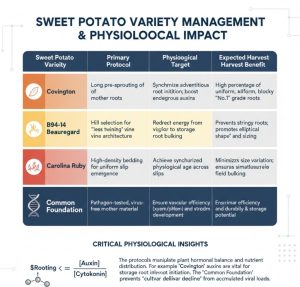
Variety-Specific Morphogenesis and Nursery Protocols
The decisions made in the nursery have a “legacy effect” on the storage potential of the harvested crop.
Strong seedlings possess a higher capacity for wound periderm formation (curing). If a seedling is physiologically stressed or nutrient-deficient in the nursery, the resulting tuber often lacks the metabolic reserves required for rapid suberization after harvest. High-vigor slips produce tubers that cure more efficiently, creating a biological barrier against opportunistic pathogens during long-term storage.
Nursery-stage health influences the hormonal balance (specifically the Abscisic Acid to Gibberellin ratio) in the mature tuber. Plants grown from high-quality, virus-free slips tend to maintain a deeper state of post-harvest dormancy. This lowers the metabolic heat production within storage facilities, allowing for a 12-month storage window without significant degradation of starch content or organoleptic qualities.
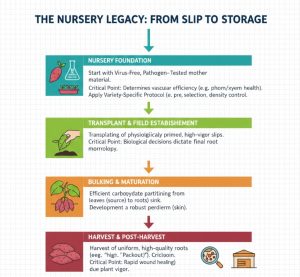
The link between nursery-stage biological management and final crop performance is absolute. By manipulating seedling vigor, ensuring viral sterility, and employing cultivar-specific priming techniques, SPI stabilizes the complex variables of sweet potato morphogenesis. These technical interventions ensure that the biological potential of the plant is fully realized in the form of high No.1 packout ratios, superior periderm strength, and prolonged post-harvest stability.
